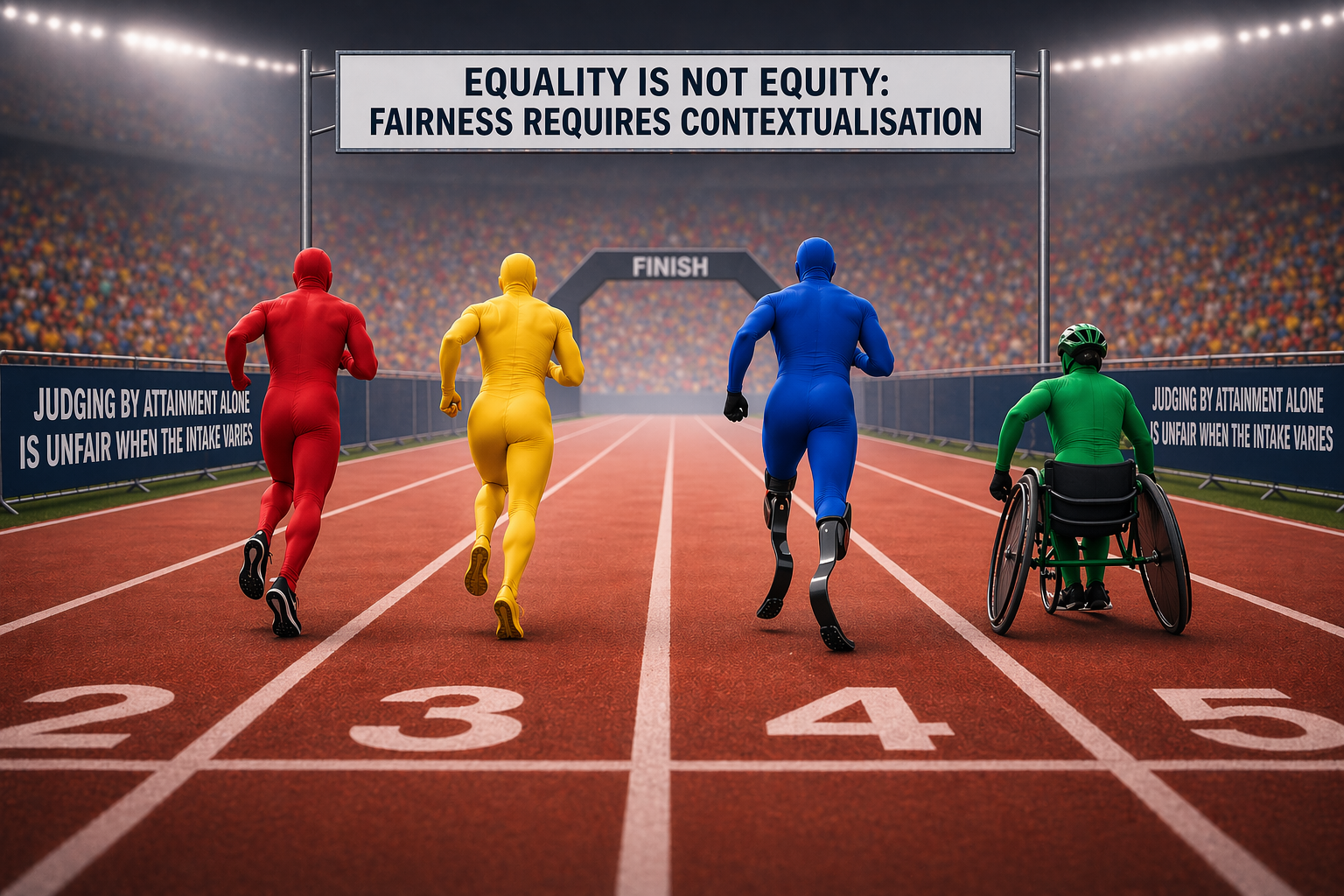
In a move set to send shockwaves through the world of sport, the International Athletics Association (IAA) has today announced a radical overhaul of its competition structure, effective immediately. Following a landmark decision, the IAA will no longer publish separate performance categories based on gender or disability, arguing that such distinctions perpetuate a “quiet curse of low expectations.”
Speaking from their headquarters, an IAA spokesperson declared, “For too long, we have been holding back athletes by placing them in separate boxes. By suggesting that women cannot compete directly with men, or that para-athletes are somehow fundamentally different and thus worthy of their own, lesser, benchmarks, we are inadvertently telling them they are not capable of true greatness.”
The decision means that from now on, all athletes will compete in a single, unified 100-meter dash. The IAA believes this will foster an environment of genuine aspiration, pushing every competitor, regardless of their physical attributes or challenges, to strive for the absolute pinnacle of human performance. “Why should we limit the dreams of a visually impaired runner by telling them their 10.82-second world record in the T11 category is ‘good enough’?” the spokesperson continued, referencing Athanasios Ghavelas’s impressive time. “We believe they, and all athletes, have the potential to chase the 9.58 seconds set by Usain Bolt. It is condescending to do otherwise.”
Critics are, predictably, outraged. Athletes and advocacy groups argue that the move is not only illogical but deeply unfair, ignoring fundamental biological and physical realities. They point to the inherent differences in speed and strength between men and women, and the profound impact of various disabilities on athletic performance. “This isn’t about low expectations; it’s about fair competition and celebrating diverse achievements,” stated one prominent para-athlete representative. “To compare my 14.20-second wheelchair sprint, a world record in the T53 category by Pongsakorn Paeyo, directly against the times of able-bodied runners is to fundamentally misunderstand the nature of sport and human endeavour.”
However, the IAA remains steadfast. They believe that true equality lies in expecting the same monumental effort and drive from everyone. They envision a future where all athletes train with the ultimate record in mind, regardless of their personal circumstances, fostering an unprecedented era of athletic development. “Imagine the innovation in training, in prosthetics, in technique, when the goal for everyone is simply to be the fastest human being on the planet,” the spokesperson enthused.
The Uncomfortable Truth: Why Context Matters
Of course, the scenario above is a complete conceit. It’s a fictional, and quite frankly absurd, thought experiment designed to highlight a crucial point about how we interpret data, particularly in education.
The idea that we should abolish athletic categories like gender or disability because it represents a “soft bigotry of low expectations” is preposterous. It ignores the fundamental biological and physical realities that necessitate these distinctions. No one genuinely believes that Florence Griffith-Joyner’s 10.49-second women’s 100m world record represents a “low expectation” simply because it’s not Usain Bolt’s 9.58 seconds. Her achievement is monumental within its context. Similarly, the incredible times achieved by para-athletes, like Hannah Cockroft’s 16.77 seconds in the T34 wheelchair race or Petrúcio Ferreira’s 10.29 seconds in the T46/T47 category, are celebrated precisely because they are world-beating performances within their specific classifications. To suggest otherwise isn’t raising expectations; it’s being wilfully ignorant of diverse abilities and achievements.
This brings us to the real issue: the importance of contextualised school performance measures. When Michael Gove, as Secretary of State for Education, made the decision to stop publishing contextualised data for schools, he referred to them and representing the “soft bigotry of low expectations”. The argument was that by taking into account factors like socio-economic background or prior attainment when judging a school’s performance, we were effectively excusing poor results and not pushing all schools to achieve at the highest level. That argument has more recently been echoed by Ofsted’s Chief Inspector, Sir Martyn Oliver, who, speaking to school leaders at the 2026 ASCL Annual Conference, warned against what he called the “quiet curse of low expectations” and argued that recognising context must not mean lowering expectations for disadvantaged pupils.
However, just as comparing a wheelchair racer to an able-bodied sprinter is meaningless, so too is comparing schools serving vastly different student populations without any contextualisation. A school in an area of high deprivation, taking in students with significant learning challenges, might show less impressive raw attainment scores than a selective grammar school in an affluent area. But if that deprived school is adding immense value to its students, helping them make exceptional progress from their starting points, that is an extraordinary achievement that should be recognised and celebrated.
Without contextualised data, we risk penalising schools that are doing a phenomenal job with challenging cohorts, while artificially inflating the perceived success of schools that simply benefit from a more advantaged intake. It can lead to unfair league tables, inaccurate inspection judegements, misinformed policy decisions and ultimately, a system that fails to accurately identify and support schools truly making a difference. Just as we marvel at the dedication and speed of every athlete on our list, regardless of their category, we should appreciate the success of every school within its unique context. To do anything less is to apply a “soft bigotry” of misunderstanding, expecting all to run the same race on the same track, when the reality is far more nuanced and complex.